
I've been asking Americans who've been to Georgia what they remember most about the country, what made Georgia special to them. The responses usually begin with
the friendly people or memorable places: churches, mountains, castles. But those things can be found in a lot of countries, I say. What was unique to Georgia? What do you miss most? Eventually there's only one answer: khachapuri.
Khachapuri, that ubiquitous delicacy (inadequately described in English as 'cheese bread') that seems to appear on every Georgian table at every Georgian meal is, for us visitors, the essence not just of Georgian cuisine, but of Georgia herself.
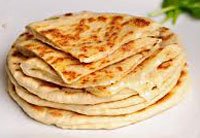
It's not just that khachapuri is delicious, either. It also seems unattainable anywhere else in the world. An American acquaintance had a Georgian-themed restaurant in Seattle in the mid-1990s. It was called Pirosmani, and the head chef was Georgian, not just some American with a Georgian cookbook. We Seattleites who had been to Georgia were lined up at Pirosmani's door the first hour of the first day. The prospect of eating a lot of khachapuri drew us. We ordered it, it came, and we tried it. 'American' khachapuri was tasty, but still very disappointing. It just wasn't the khachapuri we knew and loved.
The cook eventually explained. 'I can't get the right cheese here,' she said sadly. 'What I use is as close as I could come after months of searching.' We sympathized with her-especially my friend Lucy, who, in khachapuri-withdrawal, once tried to make it at home and encountered the same problem-but we weren't surprised when Pirosmani disappeared after a few years. A Georgian restaurant that doesn't serve real khachapuri is as doomed as a McDonald's that's run out of hamburgers.
And speaking of the world's largest restaurant chain, when I was in Tbilisi I passed the McDonald's near Rustavelli a few times, but I never went in. (Eating at McDonald's in Georgia seemed to be the cultural equivalent of taking bottles of California wine to Bordeaux.) But I was curious about one thing. In McD's in Japan, they serve a Teriyaki Quarter Pounder undoubtedly designed to provide something for the native population that doesn't care to 'eat American.' So I wondered if the McD's in Tbilisi serves khachapuri, or even (yeeks!) a Khachapuri Big Mac. Probably not, but that may change if our documentary and other efforts to attract tourists work.
But it won't be enough. Trust me on this: When millions of Americans, Canadians, Brits and Europeans start visiting Georgia, khachapuri is going to take its place with pizza, crumpets, croissants and sushi as the native dish you have to have when you go there. It's going to be very, very big. In fact, one of the Americans I talked to the other day said he had a million-dollar idea for a Georgian business.
'You get some way to cook khachapuri in a small trailer, like the taco trucks you see now in Mexico and the States,' he said. 'And you park that trailer right outside the door at Tbilisi Airport where the tourists come out, after they've gone through customs and baggage claim. Right there, fifteen feet from the door. And then you get ready, because you're going to unload just a whole lotta khachapuri.' He's right.
By Greg Palmer
Improved version: Khachapuri - the Taste of Georgia. I've asked many Americans who have visited Georgia what they remember most about the country and what made it special. Their answers usually begin with the warmth of the people or the beauty of the country: its ancient churches, magnificent mountains, and medieval castles.
"But you can find friendly people and beautiful places in many countries," I tell them. "What is uniquely Georgian? What do you miss most?"
Eventually, the answer comes: "khachapuri".
Khachapuri, that irresistible Georgian delicacy often inadequately described in English as "cheese bread," seems to appear on almost every Georgian table. For those of us who have visited Georgia, it represents not merely the country's cuisine but something of Georgia itself.
And it isn't just the taste that makes khachapuri special. There is also the curious difficulty of finding the real thing anywhere else in the world.
In the mid-1990s, an American acquaintance opened a Georgian-themed restaurant in Seattle called Pirosmani. The head chef was Georgian, not simply an American experimenting with recipes from a Georgian cookbook. Those of us who had visited Georgia were waiting at the restaurant's door during its first hour of business. We had come for one principal reason: khachapuri. We ordered it eagerly. It arrived, golden and fragrant, and we took our first bites. The American version was tasty enough, but something was missing. It simply wasn't the khachapuri we remembered and loved. Eventually, the chef explained the problem.
"I can't get the right cheese here," she said sadly. "What I use is the closest substitute I could find after months of searching."
We sympathized with her, especially my friend Lucy, who had once tried to make khachapuri at home during a particularly severe bout of khachapuri withdrawal, only to encounter the same obstacle. We weren't surprised when Pirosmani eventually disappeared after a few years. A Georgian restaurant that cannot serve convincing khachapuri faces a challenge comparable to that of a McDonald's that has run out of hamburgers.
Speaking of the world's largest restaurant chain, when I visited Tbilisi last October, I passed the McDonald's near Rustaveli Avenue several times but never went inside. Eating at McDonald's in Georgia seemed to me the cultural equivalent of bringing bottles of California wine to Bordeaux.
Still, I wondered about one thing.
McDonald's restaurants in Japan offer teriyaki burgers, presumably to appeal to customers who appreciate a local flavor. So I wondered whether the McDonald's in Tbilisi served khachapuri or perhaps even a Khachapuri Big Mac. Probably not, I thought, although that might change as Georgia attracts more international visitors.
But here's the thing: it won't be enough to introduce Georgian food to tourists in a few restaurants. When millions of Americans, Canadians, Britons, and other Europeans discover Georgia, khachapuri could become one of those essential culinary experiences that travelers associate with a country, just as pizza evokes Italy, croissants evoke France, and sushi evokes Japan.
I suspect khachapuri has a very bright future. In fact, one American I spoke with recently had what he considered a million-dollar business idea for Georgia.
"You find a way to cook khachapuri in a small trailer, like the food trucks you see in Mexico and the United States," he suggested. "Then you park it right outside Tbilisi Airport, where tourists emerge after collecting their luggage and passing through customs. Put it fifteen feet from the exit, and get ready to sell an enormous amount of khachapuri."
He might be right. Imagine arriving in Georgia for the first time, stepping outside the airport, and being greeted by the aroma of freshly baked bread and melting Georgian cheese.
Welcome to Georgia. Your first khachapuri is waiting.
How to Make Authentic-Style Georgian Khachapuri at Home
You don't have to travel to Tbilisi to enjoy khachapuri. With the right cheese, a soft dough, and a hot oven, you can make a delicious version at home. Georgia has several regional varieties of khachapuri. This recipe is for Adjarian khachapuri (Acharuli khachapuri), the famous boat-shaped bread filled with cheese and topped with an egg and butter. It is particularly impressive when served straight from the oven.
Ingredients
Serves 4 | Preparation: 25 minutes | Rising: 60–90 minutes | Baking: 12–18 minutes For the dough
- 500 g (about 4 cups) all-purpose flour
- 300 ml (1¼ cups) lukewarm water or a mixture of water and milk
- 7 g (2¼ teaspoons) instant dry yeast
- 1 teaspoon sugar
- 1 teaspoon salt
- 2 tablespoons vegetable oil
For the cheese filling
- 400 g (14 oz) Georgian sulguni cheese, grated
- 200 g (7 oz) Imeruli cheese, grated
- 50–100 ml milk, if needed to soften the filling
If Georgian cheese is unavailable:** Use approximately 450 g low-moisture mozzarella and 150 g feta. Adjust the amount of feta to taste. This is a practical substitute, not an exact reproduction of traditional Georgian cheese.
For the topping
- 4 eggs
- 40–50 g butter, divided into small pieces
- A little flour for shaping
Step-by-step instructions
1. Prepare the dough.
Mix the lukewarm water or water-and-milk mixture with the yeast and sugar. Add the flour, salt, and oil. Knead for about 8–10 minutes, until the dough is smooth and elastic. It should be soft and slightly tacky, not stiff.
Cover the bowl and leave the dough in a warm place for 60–90 minutes, or until it has approximately doubled in size.
2. Prepare the cheese filling.
Grate the cheeses and mix them together. If the mixture is too dry to spread easily, add a little milk. The filling should be moist but not runny.
3. Shape the khachapuri.
Divide the dough into four equal portions. Roll each portion into an oval approximately 25–30 cm (10–12 inches) long. Spread the cheese mixture down the center, leaving a narrow border around the edges. Roll the long sides inward toward the filling and pinch the ends together to create a boat shape. Leave the center exposed so the cheese remains visible. Transfer the boats to a baking tray lined with parchment paper.
4. Bake until golden.
Preheat the oven to 230°C (450°F). If using a baking stone or steel, preheat it as well.
Bake the khachapuri for approximately 10–14 minutes, until the dough begins to turn golden and the cheese is bubbling. Baking time depends on your oven and the thickness of the dough.
5. Add the eggs.
Remove the tray from the oven. Make a small well in the cheese filling of each khachapuri and carefully crack an egg into it. Return the tray to the oven for another 2–5 minutes, until the egg white is set but the yolk remains soft. Watch carefully, since eggs cook quickly at this temperature.
6. Finish with butter and serve.
Place a small piece of butter on top of each khachapuri as soon as it comes out of the oven. The butter should melt into the hot cheese and egg. Serve immediately, while the bread is hot and the cheese is soft. Traditionally, diners mix the egg and butter into the cheese and tear off pieces of the bread's crust to dip into the filling.
The secrets to excellent khachapuri
- Choose the right cheese. Sulguni and Imeruli are traditional choices. The combination of a good melting cheese and a tangier white cheese gives a more balanced flavor than mozzarella alone.
- Keep the dough soft. Adding too much flour makes the bread heavy and dry.
- Use a very hot oven. High heat helps produce a golden crust while keeping the inside tender.
- Don't overcook the egg. A soft yolk creates the rich, creamy finish that makes Adjarian khachapuri so distinctive.
- Eat it fresh. Khachapuri is at its best straight from the oven, when the cheese is hot and the crust is still slightly crisp.
One final tip: If you want to recreate the experience of eating khachapuri in Georgia, don't serve it as an ordinary side dish. Bring the whole boat to the table while it is still steaming, break off a piece of the golden crust, and dip it into the molten cheese, egg, and butter. That first bite might explain why visitors remember khachapuri long after they have forgotten the names of the castles they photographed. And it might even convince you that a khachapuri food truck outside Tbilisi Airport really is a million-dollar idea.


