
Simon Japaridze, who led all important ascents of Kavkasioni in 1926-28, initiated researchers into the study of the
Georgian Highlands and sparked off mass ascents of the Caucasian peaks. Accompanied by his sister Aleksandra and Khevi dwellers, Gakha Tsiklauri and lagor Kazalikashvili, he reached the peak of Mkinvartsveri in 1927 via a new path running through Gergeti Mkinvari and installed there a meteorological station to provide weather forecasts. This caused a burst of startling international feedback. The first diagrams obtained from the mountain peak were displayed at the World Fair held in Paris. In 1928 Simon Japaridze undertook the first TV & radio expedition comprising 41 adventurers, of whom 7 were women. „Caucasian Portal“ shot at an altitude of 5043 metres, was acclaimed as the first mountaineering film. In 1929 Kavkasioni Mountain claimed the first lives: the ascent of Tetnuldi ended fatally for Simon Japaridze and Pimen Dvali.
In 1933 Aliosha Japaridze set off for a new adventure to conquer technically challenging peaks. On 31 August 1934 Aliosha and Aleksandra Japaridze, lagor Kazalikashvili and Gio Niguriani reached the south summit of Ushba, thus paving the way for difficult ascents in the history of Georgian alpinism. It is noteworthy that Levan Maruashvili, Davit Tsereteli and Aliosha Japaridze were invited to join the Pamir Expedition as instructors. Davit Tsereteli and Aliosha Japaridze were even awarded the honorary title of Pamir Hero for their tremendous contribution to the development and exploration of this region.
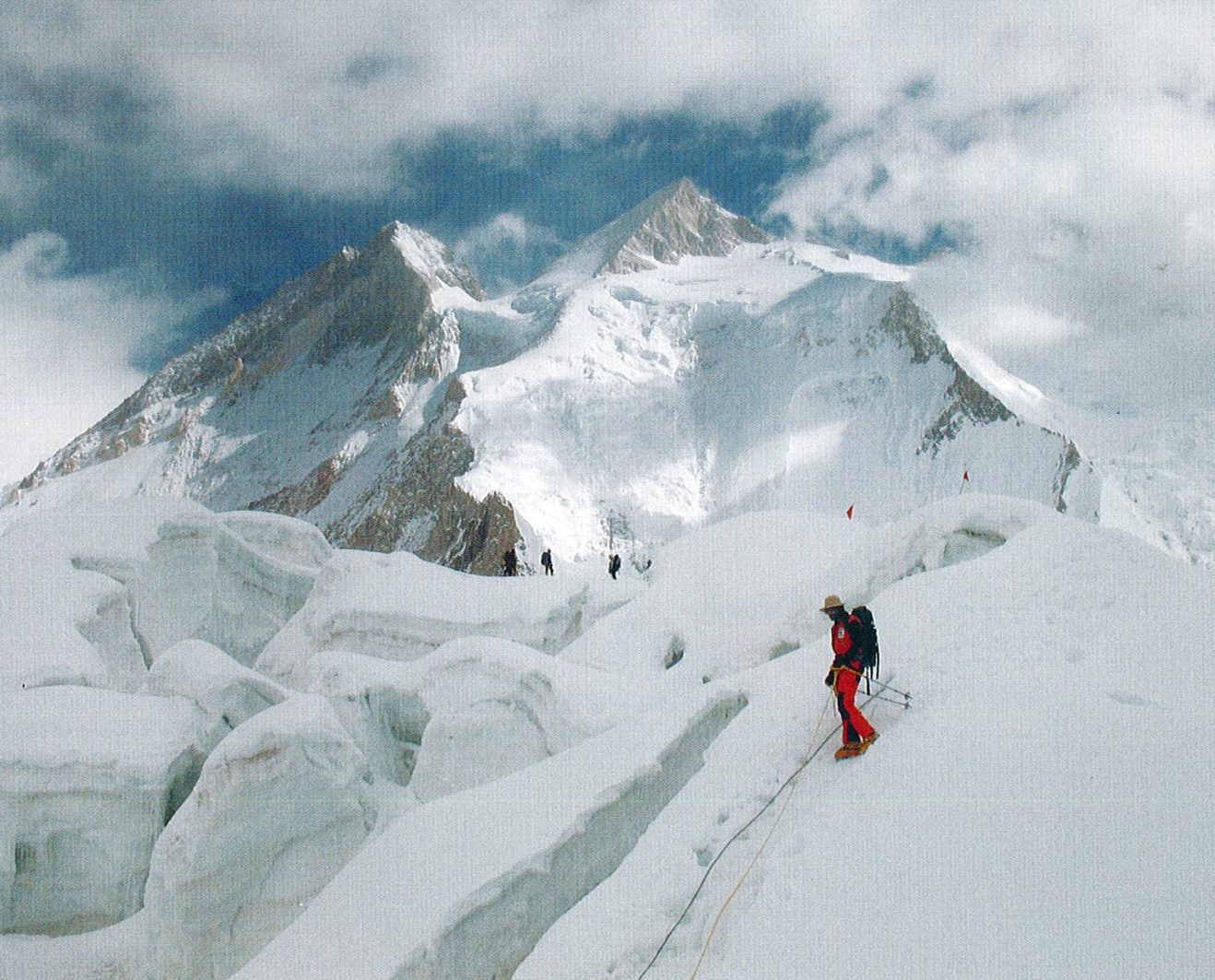 In 1936 an Alpine club was set up in Tbilisi - a first for the Soviet Union. (In 1945 the club was named after Aliosha Japaridze, one of the founders of the Georgian school of alpinism). In 1937 Gabriel, Beknu and Besarion Khergiani, Chichiko Chartolani and Maxime Gvarliani made their first most difficult ascent of South Ushba via the southeast wall. This route is still known as „Gabriel's Route“. In 1940 Aliosha Japaridze led a „big traverse“ across the highest and most rugged part of central Kavkasioni from Turungali up to Shota Rustaveli Peak. During World War II, Georgian climbers were recruited as special mountain troops to carry out military action in the highland regions. Giorgi Bakradze, Levan Maruashvili, Davit Tsereteli, Ivane (Kako) Mari and Davit Purtseladze gained notoriety for their engagement in planning and conducting military training and operations. Georgian climbers - Beknu and Gabriel Khergiani and Giorgi Sulakvelidze - removed a swastika banner that German fascists had planted atop Mount Elbrus. In the same period, Georgian mountaineers undertook the uphill task of exploring remote grottos and inaccessible caves. Aliosha Japaridze explored the caves of Khvamli, Orkhvi, Tvishi, Shiomgvime and Uplistsikhe. Aleksandra Japaridze discovered Betlemi Cave, thus unearthing the truth behind the legend about Ilia Chavchavadze's poem „Gandegili“.
In the autumn of 1945, Georgian climbers Aliosha Japaridze, Keleshbi Oniani and Nikoloz Mukhini launched an ambitious assault on the roughest Ushba-Shkhelda traverse. Sadly, though, the climbers were crushed beneath a devastating avalanche of snow as they slept in their tent overnight. This route was only traversed in 1950 by Ivane (Kako) Mari, Beknu Khergiani, Chichiko Chartolani, Goji Zurebiani and Maksime Gvarliani.
In the sixties and seventies, alpinism gained in popularity and began to be regarded as a national sport. In 1961 Georgia's national team (captained by Otar Gigineishvili) set off on a new route for the highest and one of the most difficult peaks of Pobeda (7439m). The group of alpinists (Mikheil Khergiani, Mikheil Khergiani Junior, T. Kukhianidze, K. Kuzmini and Ilia Gabliani) was led by Jumber Medzmariashvili. During the ascent Mikheil Khergiani Junior had a really bad bout of illness and was taken back to a tent. Others continued their trip and on 28 August reached the peak of Pobeda. On their return, Ilia Gabliani died of hypothermia and was buried at an altitude of 6700 metres, at the foot of the so-called pedestal. Another incident that ended in tragedy occurred when T. Kukhianidze and Jumber Medzmariashvili fell off the north counterfort and died. "It was both a great victory and a huge loss for Georgian alpinism," - Academician Niko Ketskhoveli - president of the Alpine Club, famous researcher, and public figure, said at an evening dedicated to the memory of the deceased Georgian climbers. Guram Tikanadze, founder of art photography in Georgia, perished in 1963 when abseiling down Shkhara Mountain.
In the seventies alpinists moved on to a fresh challenge and added class 6 to an alpine grading system in order to further differentiate the difficulty of ascents. In 1971 three Georgian climbers Roman Giutashvili, T. Bakanidze and T. Lukashvili ascended the north wall of Catini Mount (also known as Catini Rombus), thus preparing the way for ascents of 6th-grade difficulty. In 1976 Georgian climbers embarked on a triumphal 15- day ascent of the northwest wall of Jigit within the Tian Shan mountain range. The climbers had to contend with unremittingly awful weather conditions. The team is credited with having won six all-union medals during an eight-year time span.
February 1984 proved to be absolutely disastrous for Georgian climbers. Georgia's national team (captained by Dimitri Sharashenidze) left for Svaneti to make a winter ascent of Ushba. Climbers (D. Tarkhnishvili, M. Chichinadze, G. Zumbadze, Kobakhidze and G. Tushuri) led by Irakli Geldiashvili reached the peak via Gabriel's Route. Next day, they were joined by Roman Giutashvili's team (D. Sharashenidze, T. Sharashenidze, T. Bakanidze and J. Kelesakhshvili). On their descent, Irakli Geldiashvili, D. Tarkhnishvili, M. Chichinadze, G. Zumbadze, D. Kobakhidze and G. Tushuri were all killed after being hit by an avalanche.
In the 1990s, Georgian climbers made wonderful ascents of the Pamir, Tian Shan and the Himalayas. In 1989-91 the Four Peaks (about 7000 metres in altitude) were ascended within Pamir and Tian Shan. Georgian climbers (Roman Giutashvili, T. Sharashenidze and Aphi Gigani) set their feet on one of the most elusive summits – Pobeda.
- Sharashenidze and Bidzina Gujabidze made a number of solo ascents of Khan Tengri peak (6995 m) and the peaks of Lenin (7134 m), Korzhenevskaya (7105 m), and Communism (7495 m).
Accomplished climber Roman Giutashvili's ascent of Everest - the highest mountain on earth - in the autumn of 1991 was considered a phenomenal success of Georgian alpinism. He was the first Georgian to conquer Mount Everest. In 1992 Gia Tortladze and M. Nemsitsveridze reached the Himalayan peak of Shishapangma. In 1995 Dhaulagiri Mount (8165m) was climbed by Gia Tortladze, Bidzina Gujabidze, Gela Otarashvili and Aphi Gigani. In 1996 Gia Tortladze made his ascent of Shishapangma and Cho Oyu. In May of 1996, Beno Kashakashvili, Bidzina Gujabidze and Lev Sarkisov ascended the McKinley summit (6194m) in Alaska, North America. The Georgian expedition organized in Tian Shan in 1997 had a successful outcome: Beno Kashakashvili, Bidzina Gujabidze, Lev Sarkisov, M. Khabazi, I. Ugulava and T.Sharashenidze climbed two seven-thousanders - Khan Tengri (7010 m) and Victory Peak (7439m) - and discovered the remains of Ilia Gabliani who had perished in 1961. A documentary 'Towards the Northernmost Seven-thousander' was produced, which won a prize at the Moscow International Film Festival. In 1998 Georgian climbers Beno Kashakashvili, Bidzina Gujabidze and Gela Otarashvili, along with Kazakh Ashirov, embarked on one of the world's most popular and increasingly treacherous routes - El Capitan located in Yosemite National Park - and filmed a documentary called 'Rendezvous with El Capitan' that won an award at the Moscow International Festival of Mountaineering and Adventure Films. Beno Kashakashvili was awarded the festival's top prize for the most impressive camera work in extreme conditions. In 2001 Beno Kashakashvili (captain), Aphi Gigani and Gela Otarashvili on an expedition to the Italian Dolomites made a brilliant ascent of Su-Alto summit, where in 1969 Mikheil Khergiani had met his death. The documentary entitled 'Su-Alto' was awarded a special jury prize for 'maintaining alpine traditions'. In 2001 Gia Totladze climbed Everest. In 2005 Lenin Peak was reached by Lika Nozadze - the first Georgian woman to have conquered a 7000-metre-high peak. In 2008 Bidzina Gujabidze and his son Irakli stormed Ama Dablam Mountain in the Himalayas. An ascent of Gashebrum-I was made by Bidzina Gujabidze and Avto Tsintsadze. Like many other sports, alpinism today faces tough challenges, whether from a financial, technical or moral standpoint.
According to Mr. Givi Kartvelishvili, in the challenging economic and political times of 2008, the Georgian telecom company MagtiCom provided the Georgian National Mountaineering Federation with a broad level of assistance: Georgia's national youth team made a pilot two-week ascent of Chaukhi Mountain. Young climbers ascended Mkinvartsveri Mountain and then skied their way down the slope; skillful rock climbers were sent to Italy to attend the master classes they sorely needed. The company contributed to the Lagor Kazalikashvili Mountaineering Museum in Stepantsminda; helped to organize a veteran alpinists ascent of Mkinvartsveri to mark the 85th anniversary of sport alpinism. Among the aged sportsmen was Giorgi Rostomashvili, 72. Moreover, Guram Kalandadze turned 72 atop the mountain. It can be described as an individual act of heroism comparable to that required to set a Guinness World Record. MagtiCom also contributed to the cost of publishing a book on Georgian Alpinism.
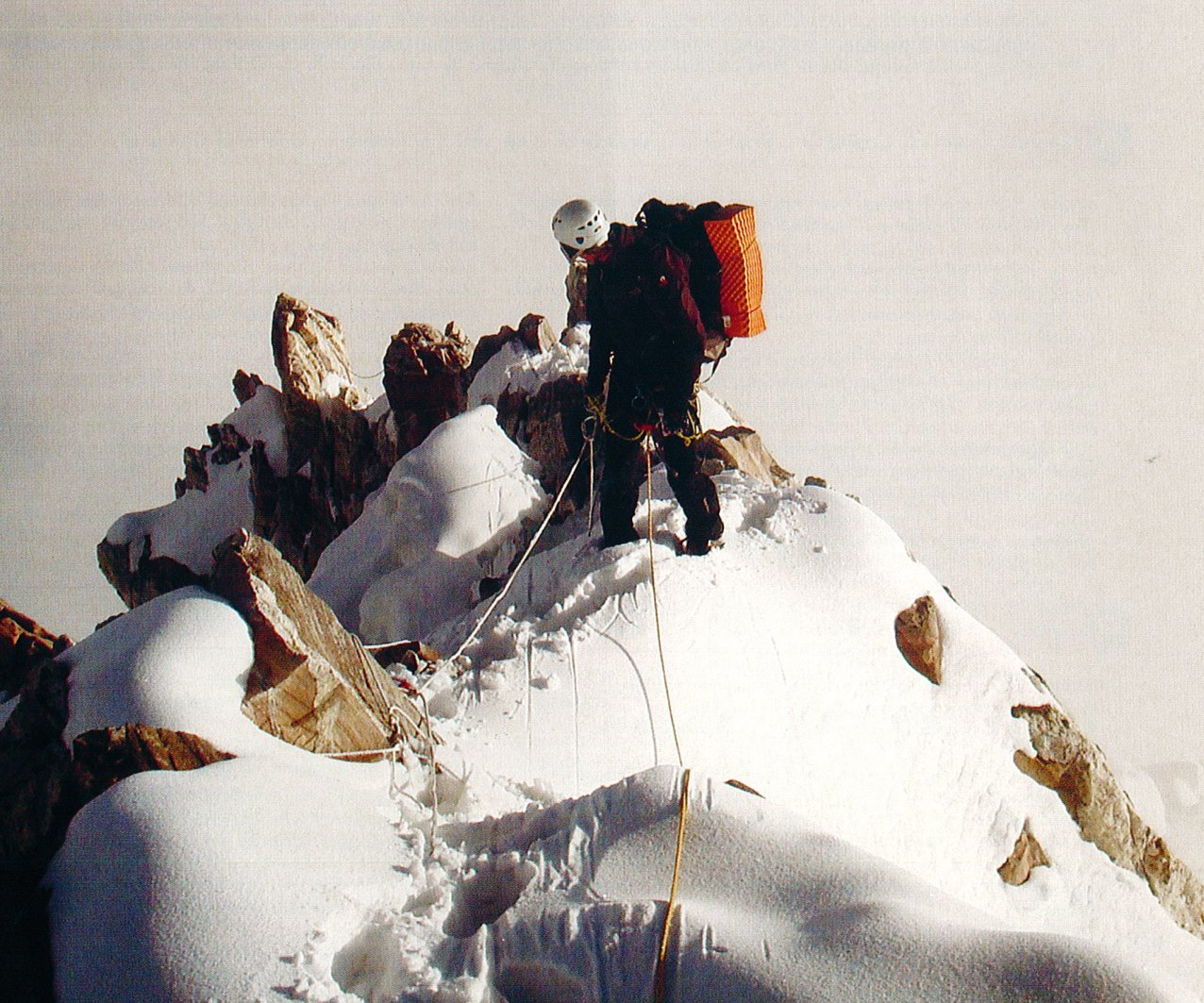 Bidzina Gujabidze - professional alpinist, twice Everest conqueror (in 1999 – from the south, in 2003 – from the north) and a participant of a great number of record ascents – „I've been in the habit of meandering through a landscape of remote mountain areas for over thirty years, often accompanied by my wife and four children. I've had an amazing series of adventures, of which the Kavkasioni ascent is the most glorious. It involves combined climbing, technically unyielding treks, abysses, ice, rock, dramatic weather changes that require raw vigour and vitality and, most importantly, a broad level of knowledge, including accomplished climbing skills, medical expertise, trauma techniques, rescue efforts, weather forecasting, gas/electric welding skills... But knowledge usually comes from experience. It is incorrect to say: „I was infected by a lust for mountains“, or „I've conquered a mountain“, or „I've stormed a mountain and claimed victory over it“. Mountains never tolerate arrogance. They require climbers to show a great sense of control, total pinpoint accuracy in planning every detail of both ascent and descent and a constant readiness for unpredictable changes. I devote all my ascents to the memory of my friends who've lost their lives to mountains.“
Mr Avtandil Tsintsadze, (1964 - ), became the 11th Georgian climber to climb Mount Everest (in total 11 Georgian climbers have conquered Everest), the world's highest peak. He is the president of the Georgian Mountaineering Federation since 2019), who is also a cardiologist at the Jo Ann Medical Center, set foot on the 8,848-meter peak at 9 a.m. on May 16, 2019.
In 2021, Archil Badriashvili, Giorgi Tepnadze and Bakar Gelashvili completed the first ascent of the north-western wall of Saragrar. The ascent was made in alpine style for eight days along the unconquered northwest wall from the Rosh-Gol valley and brought them the "Golden Piole" award of 2022. Unfortunately, mountaineering is a sport that regularly takes the lives of some people who are in love with it. On August 10, 2024, Archil Badriashvili, while completing the Shkheldi traverse, while descending from the eastern summit in Georgia, due to worsening weather conditions, a thunderstorm, and lightning caused Archil to slip off a cliff and die.
Based on Baia Sharashidze’s article


 Simon Japaridze, who led all important ascents of Kavkasioni in 1926-28, initiated researchers into the study of the